Today we're landing once again in the magical Dolomites. This time I'll tell you about impressive peaks and the beautiful trails leading to them. In other words, the best things around Falzarego. This is the second post where I talk about this beautiful pass. If you somehow missed the first one
Lagazuoi
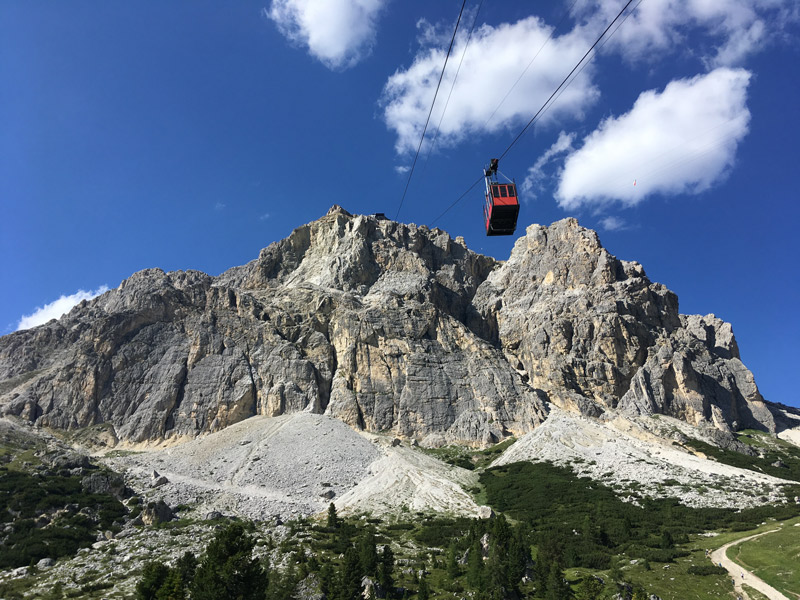
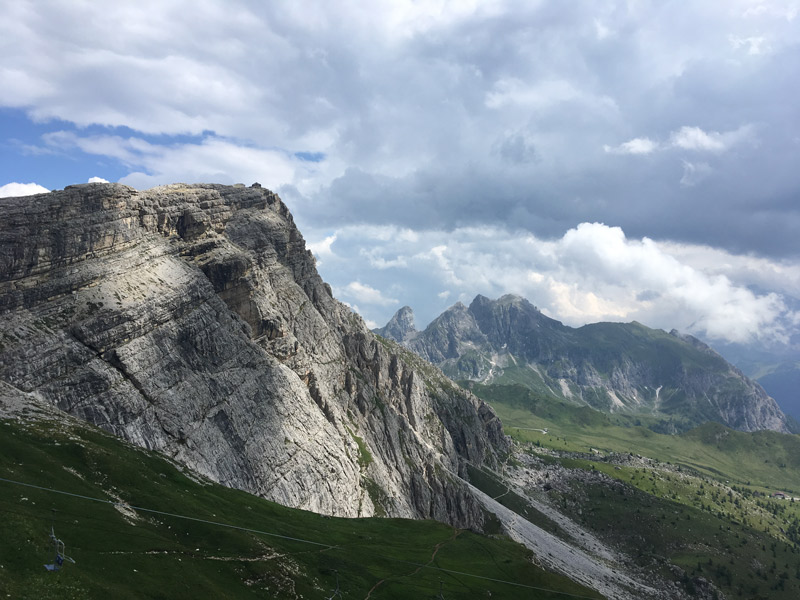
Lagazuoi towers over Falzarego Pass and is definitely the most popular destination here. Mainly because of the cable car, which allows you to reach the summit quickly and easily. The mountain consists of two peaks - Piccolo (Small) Lagazuoi (2788 m a.s.l.) and Grande (Big) Lagazuoi (2835 m a.s.l.). The cable car leads to the smaller one, where most of the World War I memorabilia is located. You can reach the summit in several ways, all starting at the cable car station on Falzarego Pass. Each ascent takes about 2.5 hours. Here they are:
trail along the ski slope. You need to go around Piccolo Lagazuoi on the right side. The easiest way, often chosen for descent after taking the cable car up or after ascending via other trails. Therefore, expect quite a lot of people there.
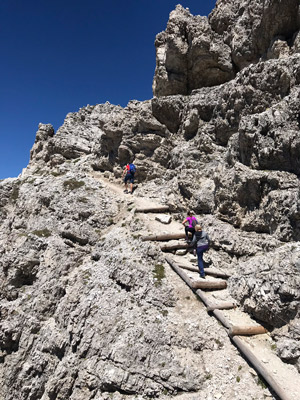
via ferrata Kaiserjägersteig. In my opinion, the most interesting option. To take this route, we must follow the trail along the ski slope, after about 500 meters turn left. It's an easy via ferrata with difficulty A where you don't need equipment. However, I would recommend renting a helmet and headlamp before entering to explore the tunnels from World War I.Kaiserjägersteig For people unfamiliar with mountains (and elevation gain in general) and children, I would additionally recommend renting a lanyard. You can never be too careful :) Along the way, one bridge and several interesting places secured with steel cable await us. A beautiful, varied route with views of Marmolada and the Sella Group accompanying us. Full-on Dolomites!
fortifications from World War I. Lagazuoi was the site of heavy fighting during World War I and this is where the largest system of mountain fortifications in all of northern Italy is located. It is now largely restored and open to visitors. You must have a helmet and a light source with you. And watch your step carefully :) I recommend considering this option, a very interesting and educational experience. I chose it for the descent, but you can also ascend this way. You need to go along the ski slope and after about 10 minutes of walking, go left towards the wall following the signs.
At the top, there's a refuge and many beautiful views of a large part of the Dolomites. You can see the Tofane massif, Marmolada, Sella Group, Civetta very well... Ah, it's pointless to talk about it - you have to see it with your own eyes :) I personally chose the option of ascending via ferrata Kaiserjägersteig and descending through the fortifications. A very varied combination and above all, there weren't big crowds along the way.
Cinque Torri
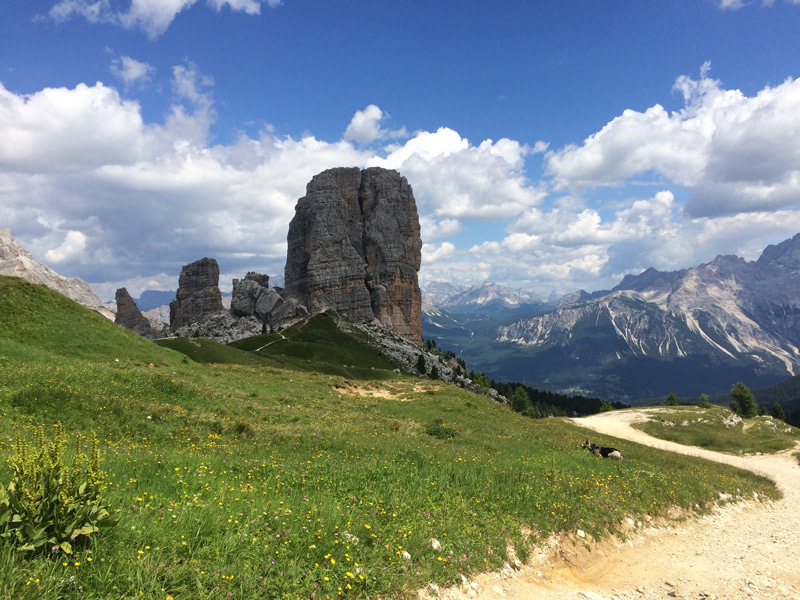
This is a characteristic group of rocks between the town of Cortina d'Ampezzo and Falzarego Pass. The name literally means "5 towers" and perfectly captures the character of this beautiful formation. The highest tower is called Torre Grande, its highest point is at 2361 m a.s.l. Only climbing enthusiasts can enjoy the view from the summit, where a true eldorado awaits them. Routes start from grade III difficulty and attract crowds of fans of this sport every year. However, ordinary mountain bread eaters won't have reasons to complain either - around Cinque Torri there's a rich network of trails and two refuges. You can reach the towers themselves by cable car or by car (only at certain hours). The immediate vicinity of Cinque Torri was the site of heavy fighting during World War I and right under the rocks, shooting positions from those times have been reconstructed - a place worth visiting!
Nuvolau and Averau
View of Nuvolau, on its summit there's a refuge[/caption] These are two characteristic, neighboring peaks located between Giau and Falzarego passes. On the pass between them is the Rifugio Averau (2416 m a.s.l.), which is essentially quite a busy restaurant due to easy access via cable car from Giau. We can reach Rifugio Averau in several ways, both from the mentioned Giau Pass and from Falzarego. The approach to it from Falzarego (we started at the Col Gallina refuge) is a beautiful and not difficult 1.5 hours. You can shorten the route by taking the cable car to Rifugio Scoiattoli under Cinque Torri. An easy trail leads to the lower Nuvolau (2574 m a.s.l.). At the very summit, above a precipice, the oldest refuge in these areas awaits us - Rifugio Nuvolau built in 1883. As one of the few in these highly touristy areas, it has retained its original, wild atmosphere.
and here's Averau Conquering the higher Averau (2649 m a.s.l.) requires having via ferrata equipment, because one short (the ferrata itself is only 15 minutes), but very interesting route with difficulty B awaits us. I definitely recommend it, because the view from the summit is stunning - in good weather we have a panorama of a significant part of the Dolomites. Unfortunately, we encountered stormy weather and most of the view was hidden in clouds. The whole adventure from the refuge is less than an hour, so the effort isn't enormous :)
Sasso di Stria
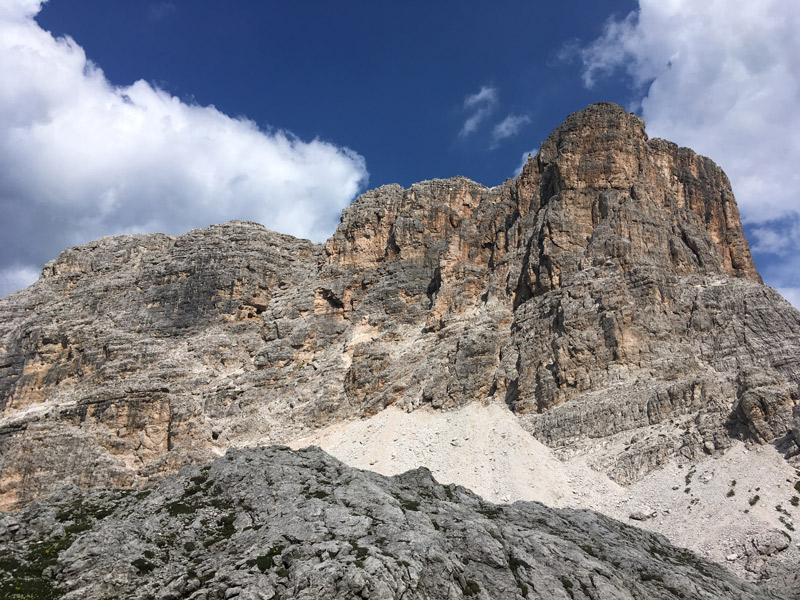
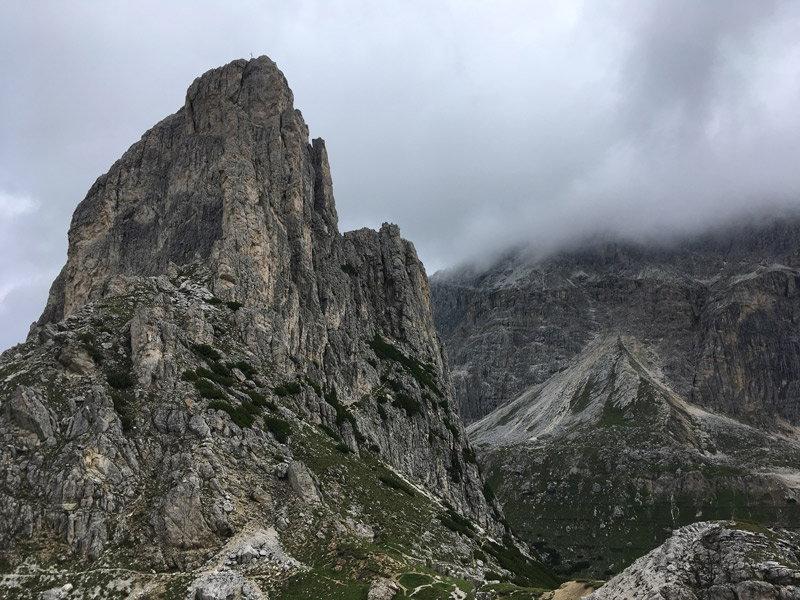
The steep and characteristic "Witch's Rock" (German: Hexenstein) is located between Falzarego Pass and Valparola, reaching 2477 m a.s.l. This is another peak that was turned into a fortress during World War I. At its foot lies the Tre Sassi fort, which defended the border of the Austro-Hungarian Empire. However, it was outdated for the types of weapons of the time, so from the beginning of military operations, the Austrians secretly built fortifications on Sasso di Stria. Currently, a large part of them has been restored and made accessible to visitors. The route to the summit from Falzarego Pass takes only an hour, at the very end an easy via ferrata awaits us (equipment is not necessary), which can however be bypassed through tunnels carved in the rock. For climbing enthusiasts, routes of very different difficulty levels await. Something nice for everyone.
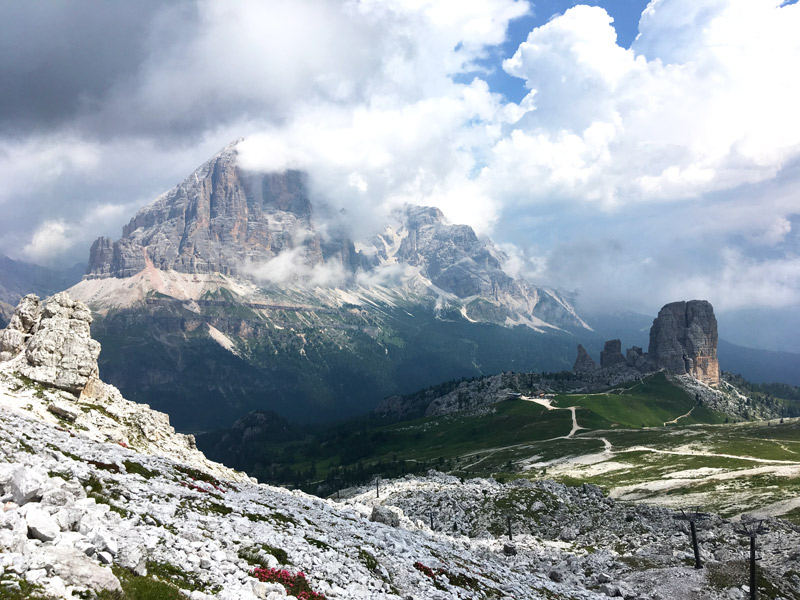
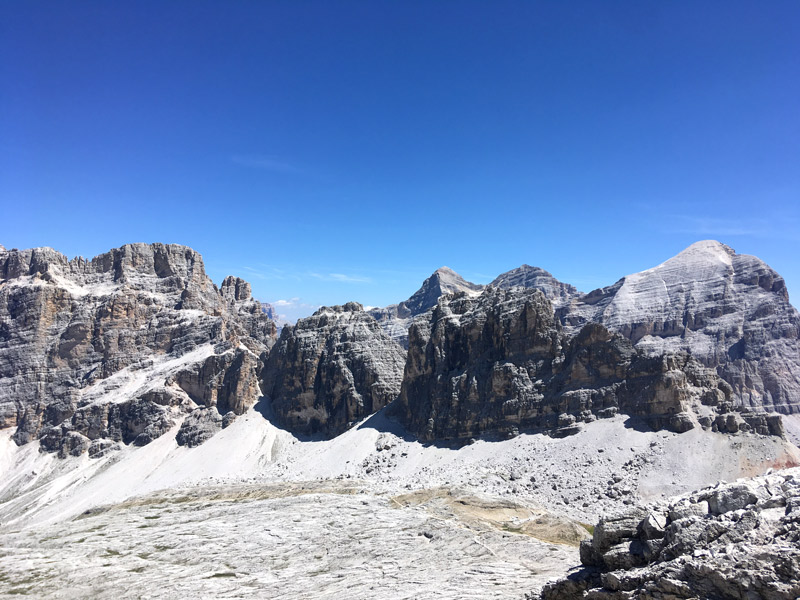
TofaneFrom left - Tofana di Rozes, Tofana di Mezzo and Tofana di Dentro I saved the best for last. The Tofane massif is definitely the most interesting mountain destination in these areas - it consists of 3 peaks, each of them among the 10 highest in the entire Dolomites. They tower over the town of Cortina d'Ampezzo. The lowest Tofana di Rozes (3225 m a.s.l.) is a standalone peak, separated from its higher sisters by Fontananegra Pass (2561 m) where the Giussani refuge is located. The 800-meter-high southern wall is one of the most impressive in the entire Dolomites and belongs to the climbing classics of these areas. You can reach the summit either by an easy trail from Rifugio Giussani, or via ferrata Giovani Lipella with difficulty C/D starting at Rifugio Angelo Dibona. The next, middle peak is the highest Tofana di Mezzo (3244 m a.s.l.). This is the most busy of the sisters due to the possibility of taking a cable car almost to the summit itself. Besides that, you can conquer it using several interesting via ferratas - Giuseppe Olivieri (difficulty C/D), Gianni Aglio (D), or the one leading from Tofana di Dentro Via Ferrata Lamon with difficulty B. The last Tofana di Dentro has a height of 3238 m a.s.l. and is connected by a ridge with Tofana di Mezzo through which runs the previously mentioned Via Ferrata Lamon. This is the most popular way to conquer this peak. Another, more difficult option is Via ferrata Formenton (B), starting at Rifugio Ra Valles (2470 m a.s.l.).
Summary
You've just learned about the most important peaks at Falzarego Pass. Nothing remains for you but to plan your vacation and see their charm with your own eyes. I guarantee you'll fall in love with them from the first ascent, just like me. I'll definitely return there next year, because this year's trip was short and I didn't manage to do even half of what I wanted :) I still have almost the entire Dolomites to discover, because the peaks presented are only a fraction. One pass further we already have completely new beautiful adventures to experience, and at the same time we can admire those already completed from a completely new perspective. And how can you not love these areas?
Cookie Settings
We use cookies to analyze website traffic and optimize your experience. You can choose which cookies you allow.
Cookie Settings
We use cookies to analyze website traffic and optimize your experience. You can choose which cookies you allow.
Necessary
Required for the website to function properly. Cannot be disabled.
Analytics
Help us understand how visitors use our website to improve it.